Showing posts with label Neivedyam. Show all posts
Hi!! Its been awhile since I blogged and am back after the long break...
Happy Vinayaka Chaturthi to all of you...


Come Vinayaka Chaturthi and the first thing that comes to my mind is the yummy Kozhakattai (pronounced as ko-ḻa-cut-aye) that mom makes...They are rice flour dumplings stuffed with either a sweet or salty filling.
Here I give the traditional recipe from my mother.

Prep. Time : _____ I leave this empty! It is ofcourse a bit time consuming for beginners.... I took about 2- 2 1/2hours when I did it for the first time! uff... (end product is worth the effort though ;)) It will improve with practice.
The quantity given below makes around 45 Kozhakattais.

INGREDIENTS:

Outer Covering:
Rice: 1 1/4 cup
Salt: 1/4 tsp
Sesame Oil: 2 tblspn
Water: 2 1/2 cups

Sweet Filling:
Fresh Coconut: 1 1/2 cup
Powdered Jaggery: 1 cup
Cardamom Powder: a few pinches

Uzhundu (Lentil) Filling:
Urad dal: 1 cup
Green chillies: 4-5 nos.
Hing: a few pinches
Fresh coconut: 1/4 cup
Chopped Corriander: 1/8 cup
Mustard seeds: 1 tsp
Oil: 1 tsp
Salt as per taste


METHOD:

1. For the covering:
Soak the rice over night. Grind the rice into a smooth paste by adding a little amount of water each time. The amount of water added shouldnt exceed twice the amount of rice used.
In a thick bottomed pan, add the sesame oil, the ground rice batter and salt.
On a medium flame, keep stirring the mixture. As the rice starts getting cooked, it will start forming lumps. Keep stirring (good exercise for your arms).
The contents will combine into one single mass.
The dough is done when there is a shine on the outer layer. Keep this closed with a lid.
To avoid the dough from becoming hard and cracked on the outside, you can cover it with a wet muslin cloth/ kitchen napkin and then cover the container with lid.
You can also prepare the same using ready made rice flour. The proportion for the rice flour and water is 3/4:1. I prefer the soaking method though.

2. Sweet Filling:
Take the coconut scrapings and jaggery in a thick bottomed pan. On a medium flame, heat the mixture. Keep stirring till all the jaggery is melted and the contents combine into a mass. This would take about 10-15 minutes. Add the cardamom powder and the filling is ready.
You can use either fresh/frozen coconut or the dry coconut powder. Fresh/frozen gives the best results. However, if you have just the dry coconut powder, follow the same procedure. In addition sprinkle some water when you start melting the jaggery.

3. Uzhundu (Lentil) Filling:
Soak the urad dal for about 2-3 hours. Grind the soaked dal, salt, chillies and hing into a coarse paste. In a pan, heat a spoonful of oil, add the mustard seeds.
Once they sputter, add the ground paste. On a low flame, stir the mixture.
As the dal starts getting cooked, it will become a powder.
Add the coconut and chopped corriander leaves and the Uzhudu filling is ready.

4. Putting it all together:
Now with the dough for the covering made in step 1, punch it like chapathi dough to make it workable (take small portions at a time). Use a mixture of sesame oil and water to avoid sticking of the dough.
Make small pouches out of the dough, fill it with sweet filling or urad filling and close the pouch.
Usually the sweet ones are made into a round shape, closing the pouch by pinching together the ends and the urad filled ones are made into a oval shaped pouch. The ends of the pouch are sealed well.
Keep all these closed with a wet muslin cloth.

Steam for about 10 minutes. I used idly plates and cooker to steam.
Yummy Kozhakattai is ready!

Unfortunately since my camera is damaged, I could only get the final dish with a cell phone. Will post the pics for individual steps next time.

Wishing you all a Happy Vinayaka chaturthi again! Ganesha Bappa Morya...God Bless.
Ciao till next time...Have fun! Vidya.

Hi Friends,

Am back after a break...We shifted to a new place. After moving all by ourselves and setting up our new home am back to blogging.. :)

Yesterday being a full moon day (Pournami) we performed Sathyanarayana Pooja. This pooja can be done on any day, full moon day is supposed to be more auspicious...

Here I post the recipe for the prasadam thats made for the pooja...

INGREDIENTS:

Rava/ Sooji: 1 cup
Ghee: 3/4 cup
Sugar: 1 cup
Milk: 2 cup
1/2 Thinly sliced Banana


METHOD:

Heat a heavy bottomed pan and add the ghee. When it melts add the rava and roast over a medium flame. When it is slightly brown, add the banana and saute well.
When this mixture is well roasted add the milk, mix well without lumps and cook with the lid closed.
After about 2 mins when the mixture is cooked, add sugar and mix well. 
Heat till the sugar melts and mixes well with the rest of the ingredients. 
The prasadam is ready when the ghee starts leaving the sides. 

The speciality of the dish is that it doesnt use any cardamom or cashew or raisin like the normal kesari/sheera. The flavour comes from the banana and ghee. 

Ciao till next time...Have fun! Vidya.
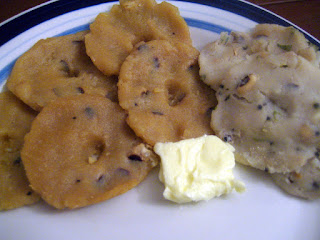
Based on the story of Satyavan and Savitri each region in India observes a fast in different time of the year. For tamilians, it is called Karadayan Nonbu or Viratham and is observed during the transition of the month Maasi into Phanguni. 

Let me tell you the story briefly. Savitri was the beautiful and intelligent daughter of king Ashtapathi. She had the permission to choose her husband. One day she saw Satyavan in the forest carrying his blind parents in two baskets balanced on either side of a stick. Impressed by his devotion to his parents, Savitri decided to marry Satyavan. Satyavan was under the curse that he would die within the next one year. Even after knowing this, she was adamant and got married to him. 
One year passed happily and then she realised that the time had come for him to die. She started following him wherever he went and she kept this fast. She cooked a special offering to God (adai) and served the same to her family.
One day, while cutting woods Satyavan fainted and she knew that his time had come. She could sense Yama, the God of death around and she followed him as he carried her husband's soul. 
Yama ignored initially thinking that she would return soon. But she persisted
 through all his tricks. Then Yama tried convincing her that it is against the law of nature to return  the life of a dead person and that he can give her three boons instead. 
Savitri agreed and asked for three boons: a son for her father, kindom and glory for her in-laws and then children for herself. 
Thus, she was successful in winning the life of her husband. 

So to this day, married women perform this viratham for the long healthy life of their husband and unmarried girls perform this in order to obtain a good partner.

Karadai with a dollop of butter is offered to God and the below mantra is chanted:

Urugda Venaiyum oru adayum nan veithen.
Oru kaalam yen kanavan yennai piriyatha iruka vendum
(I offer adai and butter to you. So that my husband and I never separate)

Vella Karadai (sweet) 

INGREDIENTS:
 
Rice flour: 1 cup
Jaggery: 1/2 cup
Kaaramani (blackeyed peas): 2 tblspns
Water: 2 cups
Grated coconut: 1/4 cup
Cardamom: 2
 
METHOD:
 
Dry roast the rice flour on a kadai (roast till golden brown or till you are able to put a like on medai with a pinch of flour). Cook the kaaramani (do not over cook: pressure cook till 2 whistles) and keep aside.
Soak the jaggery and drain.  Heat the water and add the jaggery. When dissolved, add the karamani and coconut. Mix well. Add the roasted flour at once and mix well without lumps. 
Allow to cool for a few minutes.
Make small thin patties out of the mixture and steam it (i use idly stand for this).
You can be sure that it is done properly if the adai has a shining texture and doesnt have broken edges. 

Uppu Karadai (savoury):
 
INGREDIENTS:
 
Riceflour: 1 cup
Kaaramani (blackeyed peas): 2 tblspns
Chopped green chillies: 2-3 nos.
Grated coconut: 1/4 cup
Corriander chopped: a few strands
Urad dal: 1 tsp
Mustard seeds: 1 tsp
Asafoetida: a pinch
Water: 2 cups
Salt as per taste
 
METHOD:
 
Roast the flour and cook the kaaramani. Keep aside.
Temper the mustard seeds, green chillies, urad dal and asafoetida. Add water and bring to a boil. Add kaaramani, coconut, corriander and salt to this. 
Next, add the roasted flour in one shot and mix well. 
Allow to cool for a few minutes. Make small thin patties and steam.
You can be sure that it is done properly if the adai has a shining texture and doesnt have broken edges. 
 
Wish you all a long happy life with your partners...
Ciao till next time...Have fun! Vidya.

Kesari is a sweet dish made of rava. It can be made plain or with any of the fruits like banana, mango or pineapple.
I had a lot of mango pulp and decided to make mango kesari. 

Prep. time: 15-20 mins
Makes 3-4 cups.

INGREDIENTS:

Rava (sooji): 2 cups
Mango pulp: 1 cup
Sugar: 1 1/2 to (2 cups if you have a sweet tooth)
Ghee: 3/4 cup
Milk: 3 cups
Water: 1/2 cup
Mango essence: a few drops (optional)
Cardamom: 2 nos. (optional)
Cashews and Raisins for garnishing (optional)

METHOD:

Heat a heavy bottomed pan and add two spoons of ghee.
Roast the cashews and raisins and keep aside.
In the same pan, add the rest of the ghee. When melted, add the rava and roast till light golden brown.
Add the milk and water and mix well without lumps. (Some recipes suggest boiling the water/milk first and adding the rava to it. I prefer this way since it doesnt give any scope for lumps.)
Cover with a lid on a low-medium flame till the rava is cooked.
Next add the sugar and mix well. Add the mango pulp, essence and cardamom and mix well.
All the ingredients will combine well and you will see the ghee seperate a bit at the sides. 
Your mango kesari is ready. 
Garnish with cashews and raisins and serve hot.

Ciao till next time...Have fun! Vidya.